OVERVIEW
The Thermal Flow Meter operates by heating a sensor and measuring the temperature difference caused by the gas flow. The rate of heat dissipation is proportional to the flow velocity, allowing precise flow measurement. It is suitable for clean or slightly contaminated gases and is widely used in process industries, HVAC systems, and energy management for monitoring air, nitrogen, natural gas, and other industrial gases. Its compact design and minimal moving parts ensure low maintenance and long-term reliability.
Working Principle
The Thermal Flow Meter measures air flow based on the thermal dispersion method. A heated sensor is placed in the airflow path, and as air passes over it, heat is carried away. The cooling effect is directly proportional to the mass flow rate. The meter calculates air flow by measuring the temperature difference between sensors.
MAIN PARAMETERS
| Flow Range |
0.1 – 50 m/s (depending on model) |
| Pipe Size |
DN15 – DN300 (depending on model) |
| Medium |
Gases: air, nitrogen, natural gas, etc. |
| Accuracy |
±1% – ±2% of reading |
| Operating Temperature |
-20°C to 200°C (depending on model) |
| Operating Pressure |
Up to 40 bar (depending on model) |
| Output Signal |
4–20 mA, Pulse, RS-485 / Modbus |
| Power Supply |
24V DC / 110–220V AC (depending on model) |
| Material |
Stainless Steel or Alloy for sensor and housing |
| Installation |
Inline or Insertion type |
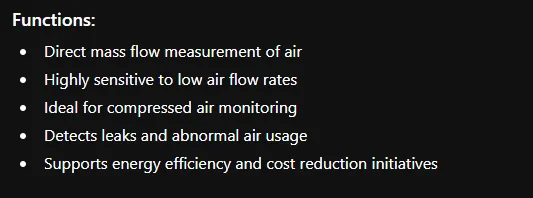
Functions